Pure Steam
Emma Jönsson (b. 1961, Katrineholm, Sweden) is an artist based in Floda, Södermanland.
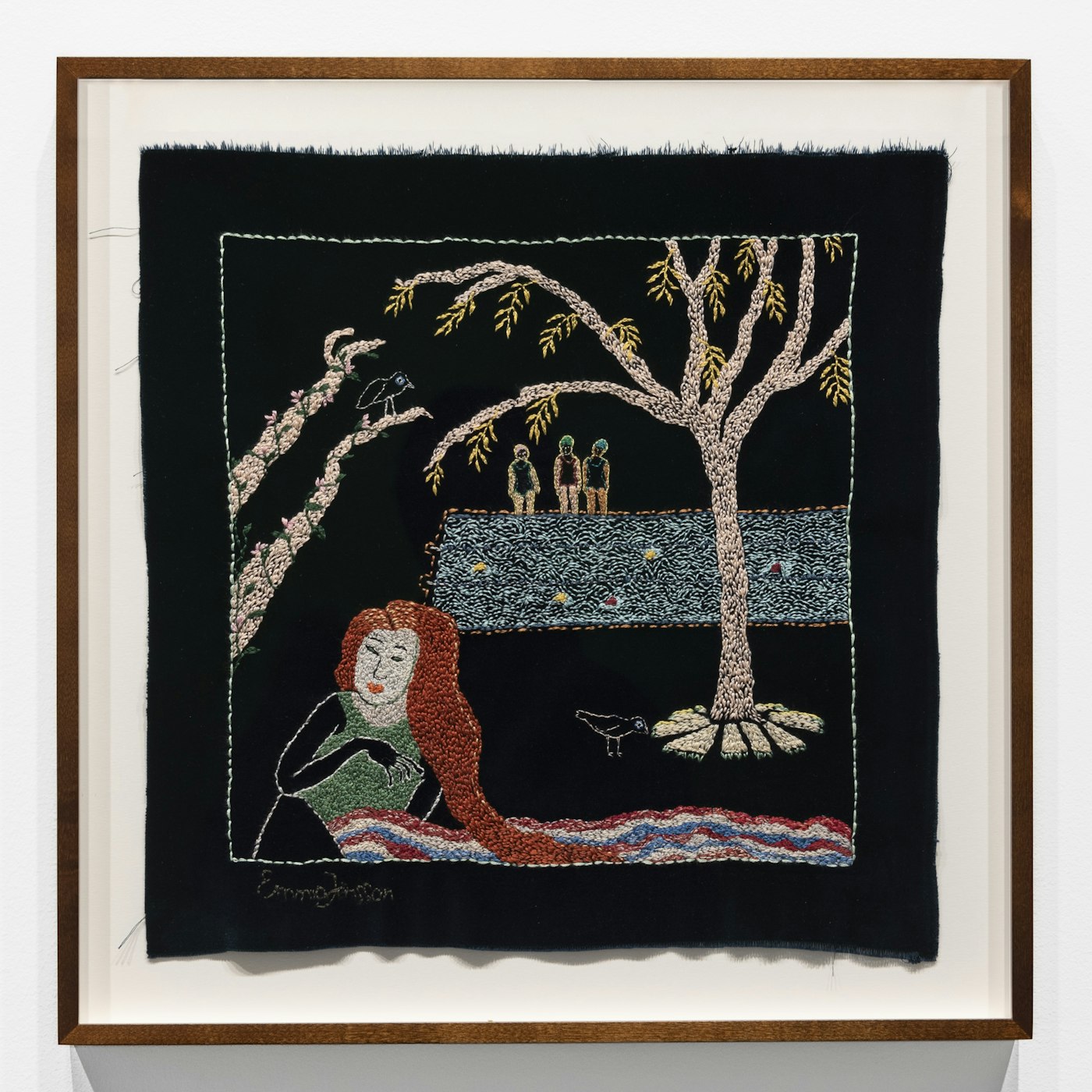
The bathhouse is a place where the body leaves traces without leaving imprints. The water washes away the visible, but the memory remains. In Emma Jönsson’s recent work the artist returns to bathhouses in Paris through the slow movement of the needle. Images imagined from memory are transferred onto dark velvet, a material that absorbs light and lets the motifs emerge from the depths. The embroidery does not become a depiction of the place but an extension of its time, where each stitch corresponds to the gradual recall of memory.
Lived spaces are kept in memory and imagination, and the places we return to are not necessarily fixed architectural reproductions, but sensory experiences where light, sound, temperature and movement weave together into memories. The Parisian bathhouses in Jönsson’s embroideries appear precisely in this way. Perspectives shift, details become clear while others dissolve. The works do not depict the bathhouses as they actually look, but as they have subconsciously been lodged into the artist’s body, and memory. The embroidery amplifies this displacement. Unlike painting’s immediate gesture, the image is built through meticulous patient repetition. By way of forms and symbols the needle becomes both a brush and a tool for thinking through the material. Each stitch records not only a shape, but also the time required to remember and bring it forth. The dark velvet simultaneously changes the conditions of the image. Velvet has historically carried associations with church textiles, princely garments, theatre curtains and upholstery. It is a material for ceremony, power and staging. However, the black and dark-blue surfaces also function as an optical depth. They absorb light rather than reflect it, so that the embroidery seems to emerge from innate darkness. The images almost appear like developing prints, where the memory slowly becomes visible, and tactile.
The bathhouse has long fascinated artists. In Paul Cézanne the bathing figures become timeless and arcadian, while Pierre Bonnard turns the bathroom into a space for everyday intimacy and the memory of light. In Félix Vallotton’s work a psychological charge arises where architecture and body are in a quiet interplay. But art history also contains other stories that relate to Emma Jönsson’s visual world and practice. Artists Berthe Morisot and Mary Cassatt make women’s everyday rituals of care and interior scenes worthy subjects, beyond the traditional nude. For Louise Bourgeois the textile becomes a bearer of memories, vulnerability and bodily experience, while Anni Albers describes weaving as its own language where the hand’s knowledge and the material’s logic create meaning. Artists Faith Ringgold and Tracey Emin use the textile tradition to tell stories, where the seam becomes a way to preserve and transmit experiences between generations.
In this tradition the thread becomes more than a material. It becomes a way to think, recollect and orient oneself in the world. The embroidery does not function as an illustration of the bathhouses but as a bodily method for returning to them. The works therefore situate themselves at the intersection of several histories: the bathhouse in cultural and architectural history, art’s recurring fascination with the bathing body, and the textile tradition of slow-knowledge production, care and material memory. Velvet and embroidery do not only carry the image but actively co-create its meaning. Emma Jönsson’s imagery moves beyond the bathhouse. It is an investigation of how places continue to live within us and how architecture is stored in the human body. How thread, textile and physical rhythm can give form to what otherwise exists only as a sensation.
Emma Jönsson received an MFA from HDK Valand in Gothenburg in 1998. Her most recent solo exhibition Waiting — Väntan at Saskia Neuman Gallery in Stockholm received prominent engagement and reception from both the public and the daily press. Her works are represented in several public and private collections; including Stockholm Konst, Örebro Municipality and Firestorm Foundation. Pure Steam is Emma Jönsson’s second solo exhibition at Saskia Neuman Gallery.
ARTWORK


PRESS
25.08.2026
Omkonst ↗Susanna Slöör
22.08.2026
Realtid ↗Viggo Cavling
25.08.2026
Svenska Dagbladet ↗Dan Backman
29.08.2026
Dagens Nyheter ↗Bo Madestrand